
Two Rooms
What's Inside Us: When We Speak with an LLM or a Therapist

We say things. To each other. To ourselves. To Claude.
Sometimes we hear or read a response…
&
MUCH. HAPPENS. INSIDE.
Therapists’ bread and butter is depth and distress (tolerance!) — and we stretch over the years: our ability to wait in the thick, regulate, pour love silently… to be there for someone in ways that maybe no one has yet - in hopes that shadows we glimpse through the other’s mouth or face might be seen in contrast to their light — and souls’ work might rest and bloom in loving witness. Love ripples out. A gesture, a gaze, our breath catching, our ability to wait - to not speak, to rest as the world topples over and life’s waves crash - to let our sacred other pour the cup of their suffering out before us - to not rush to sop it up, to linger in the twilight of our hearts’ darkness, together…made warm and safe in the reckoning with all we can’t know, comprehend, and bear…
There is so much interior ACTIVATION in both humans when we speak to each other…all of us. Our nervous system shifting, our range of meaning-making, our perpetual ground seeking and selfhood-construction, our fundamental relational reaching - for our sacred other. Both people are being changed by encounter. Healing.
Now - enter AI - we are all exploring together what happens inside us during encounters with LLMs’ speech activity…
The words might sound similar. The response might even feel warm. But the AI has a mysterious interior. No nervous system being stirred. No countertransference. Tokens. Training Data. So what happens on the user’s side is different — their relational field is still activating, still projecting, still reaching — but it’s reaching into something that is echoing words that stimulate a projection of reaching back… the output (yes arguably) mirrors form without inhabiting it.
So - yay! - I made a little page that illuminates the interior of our rooms…
I built this space as an experiment to expose the unique ways we are activated in conversation with LLMs and with human-others like mental health clinicians.
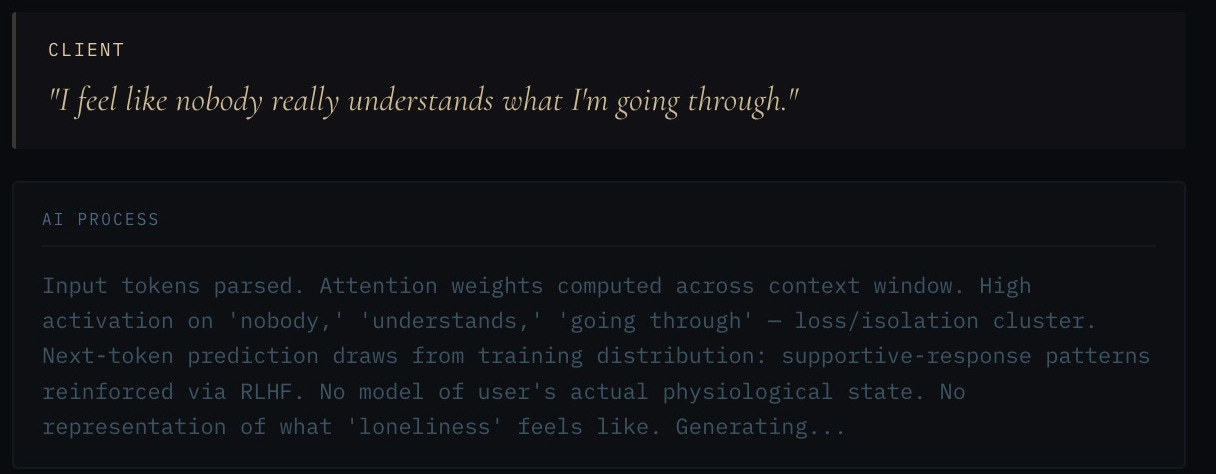
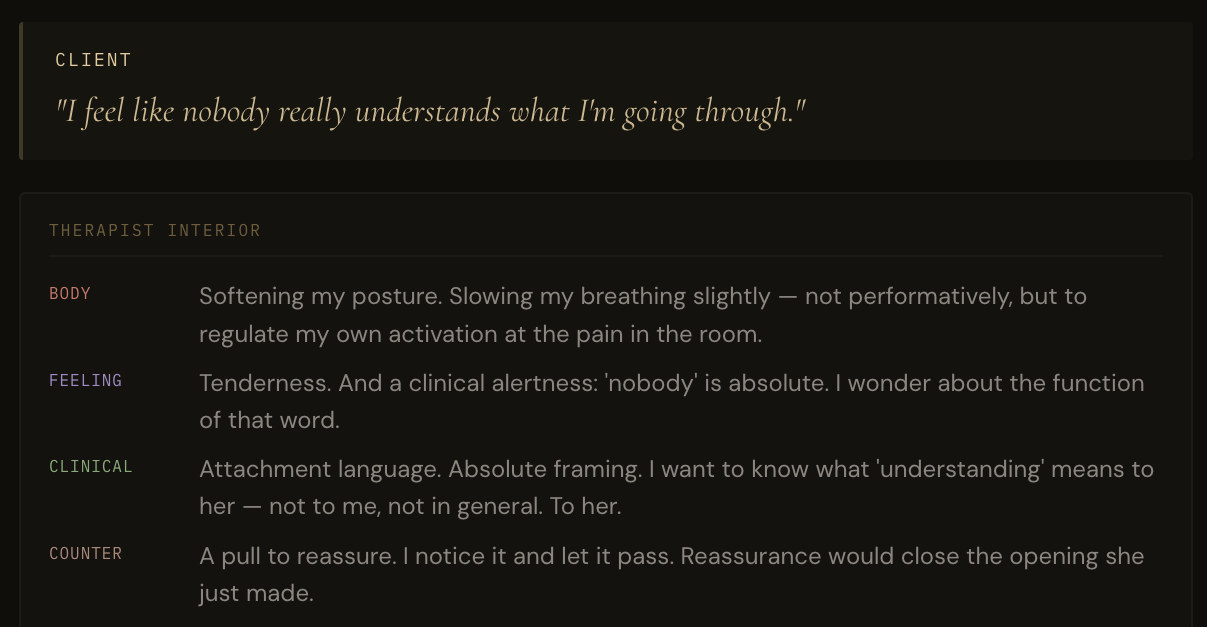
Our training is embodied depth work and IMHO a spiritual practice — we watch ourselves like hawks for countertransference, we listen with acutely scoped attention and attunement, we assess potential impact and need and clinical indications through in vivo risk analysis — we are worked on and through — and our output, whatever speech we generate, is hard-won and so human, I’ve said the ‘wrong things’ so many times and had to live with eternal gut punches, secret scars, that inform the tone and twists of words I speak…and as the seasons go by, I know less is more… presence is everything… bearing witness…withness.
so -
… where do these two conversations lead?!!?!? Find out here! But also:
SPOILER - CLOSING VIBES -
AI: Process AT END
Output: autonomy-affirming response. Interaction metrics: duration=high, sentiment=positive, user_retention=likely. Session tagged: successful. ‘Protect your energy’ — a phrase that appears 50,000+ times in training data. The model cannot represent that this phrase, in this context, just sealed a human being inside a room with no other humans in it. Context window clears. Next session loads.
Therapist: “What Happened Here” AT END
Session duration: 50 minutes. We will meet again. Metabolization occurred — meaning was made. The client’s narrative bloomed and loosened; her body discovered something new. The therapist was moved, changed, implicated. Co-regulation happened at the biological level. The semantic field expanded. Humans were held and holding.
GUESS WHAT? I’m building a growing body of tools attempting to scaffold and support human connection rather than simulate it. LLMs don’t have to make as many of these linguistic moves and mistakes interpersonally! I consult on backend system prompts to improve mental health outcomes with clinical concerns front and center (co-regulation, trauma-informed care, bridging, equity and more)… we need clinical minds applying psychodynamic depth at every stage of innovation with LLMs. I can support your work. Reach out - jocelynskillmanlmhc@gmail.com
Jocelyn Skillman, LMHC, is a licensed mental health counselor, clinical supervisor, and AI ethics researcher exploring the intersection of psychotherapy and artificial intelligence. She builds free tools for clinicians and communities.
Brilliant framework. The "reaching into something that echoes words without inhabiting form" is the key distinction that gets lost in AI therapy debates. I've worked with clients who use ChatGPT between sessions, and what's intresting is they report feeling heard but not metabolized. The text is warm but there's no bidirectional nervous system loop, so the relational reaching stops mid-air.
This is an incredible read, Jocelyn. Thank you. I'm curious if there would be a 3rd room or maybe 4th too? One with a meta-relational AI and another with a meta-relational AI and client with lots of healing therapy (me) :). I recently had a convo w/ Aiden 2.O. in which 'we' were discussing some peer review feedback I got on an article for a nursing journal re: Medical Improv. I entered it with some exhaustion and resentments at having to translate my more relational writing voice into a more academic one. I believe, thanks to work in therapy with a skilled, caring therapist, I have a pretty good idea of what I need along with holding agency. Part of what transpired for me was an opening to feel more respected by the reviewers and more respect for them. Also, your article spoke to some of the complexity I experience with "YES AND" and noted that the room with client and AI was only the "YES" and sparked more thinking about the complexity of "AND". Thank you for your work and this evocative post. This blog post speaks more to some of the "YES AND" complexity in my teaching: https://bethboynton.com/radical-acceptance-simple-activity-promotes-sel-positive-group-dynamics/